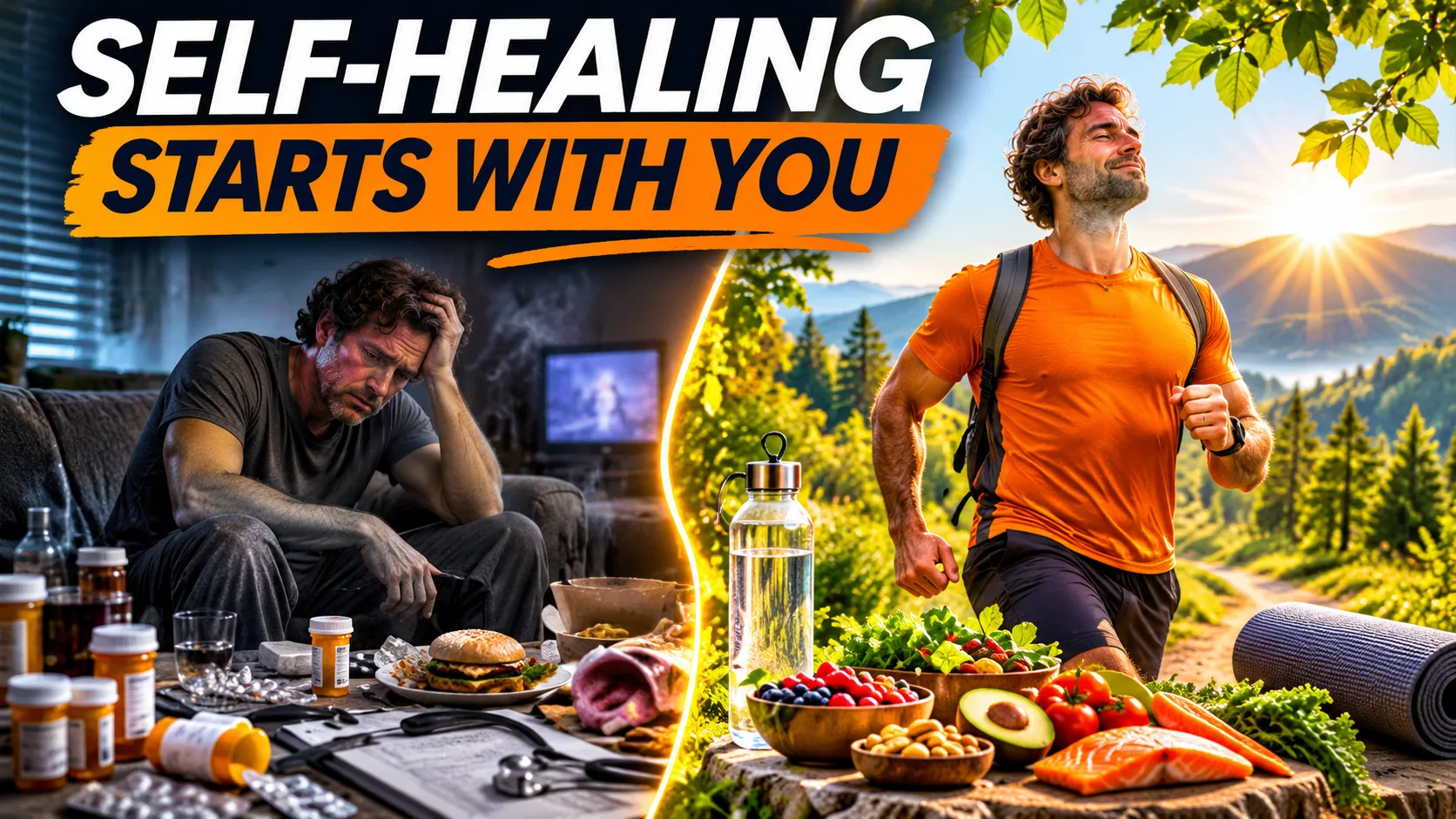
Self healing starts with you. And I believe it begins with something far more powerful than most people realize: what’s going on inside your own head.
I’ve always been fascinated by the power of belief.
Think about two people facing the same challenge. One is absolutely convinced he’ll fail. The other believes he can succeed, even if he hasn’t figured out how yet.
Which one would you put your money on?
I’ve always believed that what we accept as true, deep down inside ourselves, has an enormous influence on how our lives turn out.
Believe you’re a loser and there’s a pretty good chance you’ll behave like one. Believe you’re capable of accomplishing something and you’re much more likely to find a way to do it.
And I’ve often wondered whether the same principle applies to our health.
What if our beliefs influence how our bodies respond to illness, pain, and the challenges we face?
Well, as it turns out, there’s some fascinating research suggesting that they can.
The Placebo Effect: When Belief Becomes Physical
You’ve probably heard of the placebo effect.
Somebody is given a pill that contains no active medication, but they’re told it may help them.
And sometimes it does.
They experience genuine relief, even though the pill itself contains nothing that should produce that result.
Now, stop and think about that for a minute.
If the pill isn’t responsible for the improvement, what is?
Researchers have discovered that expectations can actually influence the body’s own pain-control systems.
A meta-analysis involving 1,183 participants examined how placebo-related pain relief can involve the body’s naturally occurring opioids.
These are chemicals your body produces itself.
So we’re not simply talking about somebody imagining that they feel better. We’re talking about the brain participating in a real physiological response.
I find that absolutely fascinating.
And it raises a question I’ve been asking myself for years.
Just how much influence does what we believe have over the way our bodies function?
We certainly don’t have all the answers. But the placebo effect gives us a pretty compelling reason to keep asking.
The Nocebo Effect: The Other Side of Belief
Now here’s where things get even more interesting.
There’s another phenomenon called the nocebo effect.
It’s essentially the opposite of the placebo effect.
Instead of expecting something to make you feel better, you expect it to make you feel worse.
And sometimes that’s exactly what happens.
In a meta-analysis of nocebo effects on pain, researchers found that negative expectations could produce measurable increases in pain.
Think about what that means.
Our expectations can influence how we experience something as physical as pain.
One person anticipates relief. Another anticipates suffering. And those expectations can influence what each person actually experiences.
To me, this is one of the most interesting aspects of the mind body connection.
It makes me wonder how many people spend their lives expecting things to go wrong, without realizing how much those expectations might be affecting them.
I’m not suggesting that every illness originates in someone’s mind.
I’m suggesting that what happens in our minds may have considerably more influence over our physical experiences than we’ve traditionally appreciated.
Why Do We Believe in Pills More Than Ourselves?
Here’s something that has bothered me for most of my life.
Why are so many people prepared to place enormous faith in a pill, a prescription, or somebody else’s opinion about their health, yet have so little confidence in their own body’s abilities?
We’ve become accustomed to expecting somebody else to fix us.
Got a headache? Take a pill.
Back bothering you? Find something to kill the pain.
Can’t sleep? Maybe there’s another pill for that.
And when the promised relief doesn’t arrive, we’re disappointed. Sometimes we become downright frustrated.
But how often do we stop to consider what else we might be able to do?
What about stretching? Yoga? Meditation? Deep breathing? Relaxation? Learning whether some of our daily habits are contributing to the problem?
These things don’t necessarily provide instant relief, and they won’t solve every condition.
But why wouldn’t we at least explore what we might be able to accomplish ourselves?
I’ve never understood why taking responsibility for our own health seems so foreign to so many people.
Perhaps it’s because we’ve been conditioned to believe that the answers must come from somewhere else.
Who Are You Putting Your Faith In?
Most people trust their doctors. They trust their diagnoses. They assume the medications they’re prescribed have been properly researched and that the recommendations they’re receiving are based on the best available information.
And I think we should be willing to question those assumptions.
Modern medicine is an enormous business. Pharmaceutical research, drug development, advertising, and treatment all involve extraordinary amounts of money.
I have serious reservations about allowing commercial interests to exert so much influence over something as important as human health.
I’ve written about those concerns in Why I’ve Given Up on Modern Medicine.
But this article isn’t really about the medical industry.
It’s about something more personal.
Where have you placed your confidence?
Have you convinced yourself that somebody else must have the answers? That your health is largely beyond your control?
Or do you believe you have an important role to play in what happens to you?
I know where I stand.
My Belief in Self Healing Is Absolute
I have an enormous amount of confidence in the intelligence of the human body.
More confidence, frankly, than I have in anybody’s ability to fully understand everything going on inside it.
That belief has been with me for most of my life.
I don’t wake up every morning wondering whether I should abandon everything I’ve learned and place my faith in another bottle of pills.
It’s simply not how I think.
I believe my body is constantly working to maintain itself, adapt to challenges, and keep me functioning.
And I believe my job is to support those abilities rather than take them for granted.
I’ve spent decades making choices based on that conviction.
I’ve been through some extremely difficult experiences, and none of them has shaken my fundamental belief in the body’s intelligence.
That’s what self healing means to me.
Not some magical promise that I’ll never get sick.
It’s the deep conviction that my body has abilities worth trusting, understanding, and supporting.
And when I believe something that strongly, I act accordingly.
Belief Changes What You’re Willing to Do
There’s another important part of this discussion.
If you genuinely believe something will improve your life, you’re much more likely to make the effort required to accomplish it.
That’s true whether you’re learning to play the piano, starting a business, or trying to improve your health.
You don’t begin by convincing yourself you’re going to fail.
You begin with the belief that you can succeed.
And then you work at it.
The same applies to self healing.
If you believe movement will help your body, you’re more likely to make time for it.
If you believe relaxation can influence how you feel, perhaps you’ll take meditation or deep breathing seriously.
If you believe that your everyday choices matter, you’re more likely to pay attention to them.
That’s where belief becomes action.
And it’s one reason I think the mind body connection deserves so much more attention.
Belief influences our expectations. Expectations influence our behaviour. And in some circumstances, as placebo and nocebo research demonstrates, expectations can also influence our physiological responses.
That’s a remarkable combination.
Are You Giving Yourself a Chance?
Here’s what I’d like people to think about.
What do you really believe about your own health?
Do you see yourself as somebody who’s inevitably going to fall apart as the years go by?
Do you assume that every new ache or discomfort requires somebody else to intervene?
Or do you believe your body has remarkable capabilities and that you can learn to work with them?
I’m not asking you to agree with every decision I’ve made.
I’m asking you to question the beliefs that may be influencing your decisions without your even realizing it.
And if you’re interested in the actual biological processes behind the body’s ability to maintain and repair itself, I’ve covered those in Natural Healing: Your Body Was Built to Heal Itself.
Here, my message is much simpler.
Don’t underestimate the power of what you believe.
Don’t automatically assume you’re helpless.
And don’t hand over all your confidence to somebody else while overlooking what you might be capable of accomplishing yourself.
Self Healing Starts With You
I’ve spent most of my life believing that the human body is an extraordinarily intelligent piece of machinery.
That belief has influenced how I’ve lived, the choices I’ve made, and the way I’ve faced life’s challenges.
And at 74 years old, I believe it just as strongly as I ever have.
I don’t believe we fully understand the power of the mind body connection. But the research into placebo and nocebo effects suggests there’s an awful lot worth exploring.
So here’s my question.
If your beliefs can influence how you experience pain, how you respond to challenges, and what you’re prepared to do for yourself, shouldn’t you be paying a little more attention to what you believe?
Believe in your body’s intelligence. Believe you’re capable of making a difference. And give yourself every opportunity to prove it.
Self healing starts with you.