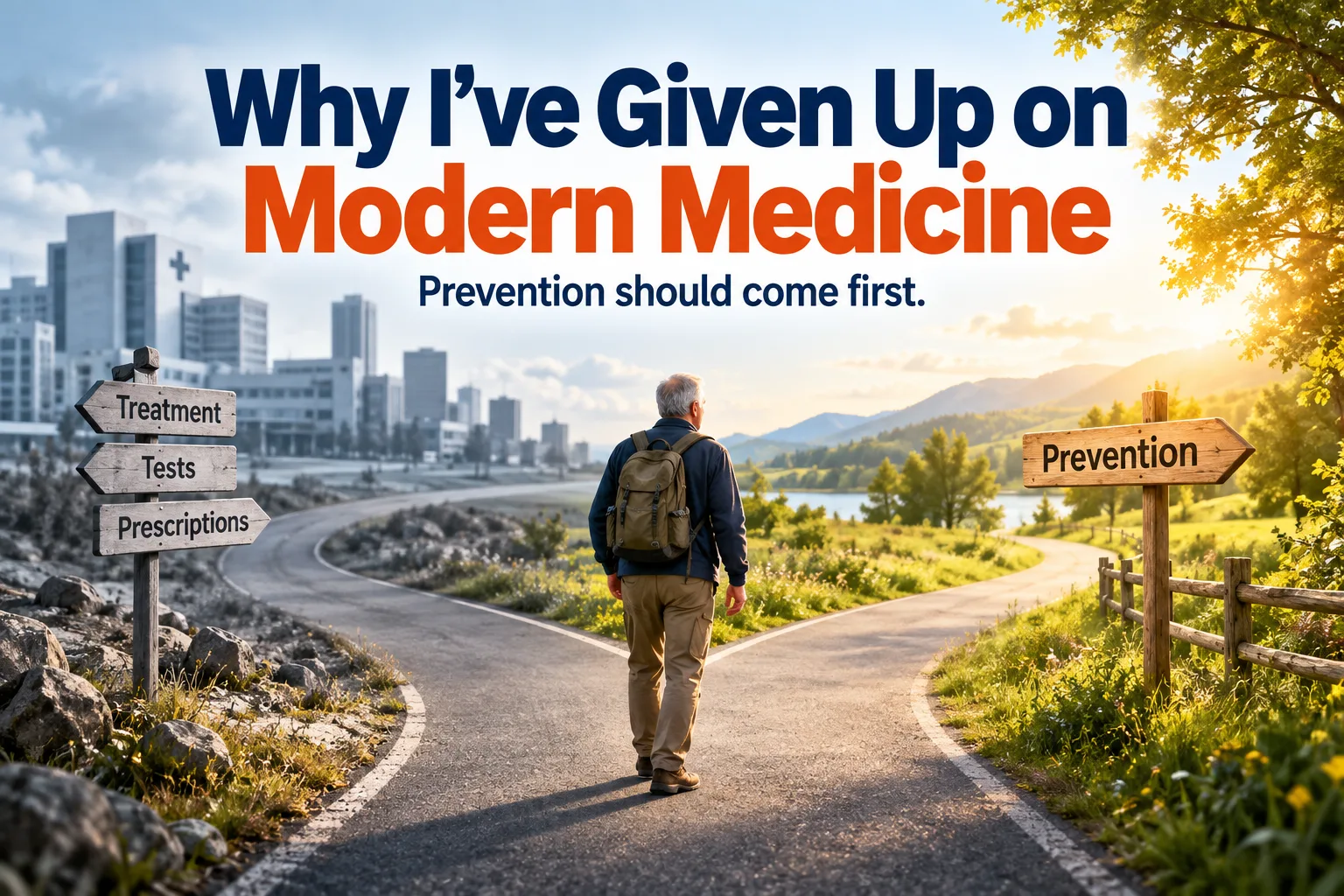
After more than seven decades of paying attention to my own health, I have become increasingly convinced that the system we call modern medicine has very little to do with keeping healthy people healthy.
That doesn’t mean there aren’t brilliant doctors, nurses, researchers and other people working inside it. Of course there are. It doesn’t mean modern medicine hasn’t accomplished remarkable things either.
My problem is with the system itself—how it is funded, what it rewards, what gets researched, what gets promoted, and where the money ultimately comes from.
And there is an awful lot of money involved.
Follow the Money
This is where my skepticism begins.
Medical research does not take place in some pristine laboratory completely separated from commerce. Drugs cost enormous amounts of money to develop, test, approve, market and sell. Pharmaceutical companies invest where they believe there will eventually be a return.
That is business.
The problem begins when we pretend that business has nothing to do with medicine.
When enormous financial interests help determine which questions are researched, which treatments receive attention, which products are promoted and which approaches become accepted medical practice, I think we have every right to ask a very simple question:
Is keeping people healthy really the primary objective?
I don’t believe it is.
A healthy person who exercises, eats reasonably well, maintains a healthy weight, sleeps properly, stays active as they age and rarely needs a prescription is not much of a customer.
A person with a chronic condition who requires medication month after month, year after year, is another matter entirely.
I am not suggesting that somebody sat in a boardroom and deliberately invented disease. I am saying the economic incentives are obvious.
There is far more money to be made managing illness than there is teaching people how not to become ill in the first place.
Modern Medicine and Prevention
This is the part that has bothered me for most of my life.
We call it a healthcare system.
Much of the time, I think it would be more accurately called a disease-care system.
You generally enter the system once something has already gone wrong.
Your blood pressure is too high. Your blood sugar is too high. You’ve gained too much weight. Your joints hurt. Your arteries are narrowing. Something shows up in a blood test. Something hurts badly enough that you finally make an appointment.
Then we begin treating it.
But where was everybody ten years earlier?
Where is the massive national effort teaching children to exercise every day?
Where is the emphasis on maintaining muscle as we age?
Where is the education about food, movement, sleep, stress and the thousands of little decisions that accumulate over a lifetime?
Where is the encouragement to understand your own body before something goes wrong?
Those things certainly exist. Plenty of good people talk about them.
But they are not what drives the medical machine.
Treatment does.
I Learned to Look at Health Differently
I began exercising when I was very young. Later I spent years seriously practicing yoga. Then came running and a lifetime of experimenting, reading, observing and trying to understand what made my own body work better.
Some of those lessons came easily.
Others most certainly did not.
My experience with mercury changed the way I looked at medicine permanently. I had to learn the hard way that something could be accepted, routinely used and considered normal while still raising questions that mattered enormously to me.
That experience taught me something I have never forgotten:
You have to remain responsible for your own health.
You can listen to experts. You can read studies. You can have tests. You can ask doctors questions.
But ultimately, it is your body.
And nobody has as much at stake in its future as you do.
Medical Science Doesn’t Exist Outside the Money
People sometimes respond to criticism of medicine by saying, “But you have to trust the science.”
I have a problem with that phrase.
Science is supposed to be a process of questioning.
It is not supposed to be a commandment.
Who paid for the research?
What was studied?
What wasn’t studied?
How long did the study last?
What questions did the researchers ask?
Were there commercial interests involved?
Could another researcher reproduce the result?
And perhaps most importantly, what research never happened because nobody was willing to pay for it?
That last question interests me enormously.
There are things that simply do not offer the same financial return as a patented pharmaceutical product.
You cannot patent going for a walk.
You cannot patent maintaining muscle.
You cannot patent sleeping properly.
You cannot patent eating ordinary nutritious food.
You cannot patent taking responsibility for yourself.
That doesn’t mean there is no research into those things. There certainly is.
It means the financial incentive is different.
And I think pretending otherwise is naive.
A Prescription Is Not the Same Thing as Health
One of the great mistakes we make is confusing the successful management of a medical measurement with the creation of health.
They are not necessarily the same thing.
A number on a laboratory report may improve. A symptom may disappear. A medication may be completely appropriate and may even save a life.
But I still want to know why the problem developed.
What happened upstream?
Could something have been done five years earlier?
Ten years earlier?
Twenty?
That is where my interest lies.
I don’t want to spend the last decades of my life managing one preventable problem after another if there are things I can do today that might reduce the chances of developing them.
There are no guarantees.
That’s important.
You can do everything “right” and still become ill. Genetics matter. Accidents happen. Disease happens. Life isn’t fair and the human body isn’t a machine with a warranty.
But uncertainty is not an excuse to surrender responsibility.
Quite the opposite.
At 74, I Still Want Control
At my age, I am not interested in handing somebody else complete responsibility for my health.
I want to remain active.
I want to remain independent.
I want to remain mentally engaged.
I want to keep moving.
And I want to understand what is happening inside my own body for as long as I possibly can.
I have watched my mother reach an extraordinary age while continuing to move and remain interested in the world around her. My father’s 1967 remarks in the Ontario Legislature about health and physical fitness influenced me as well.
Those experiences have reinforced something I already believed:
Health is something you work on while you still have it.
Waiting until you are sick is awfully late to begin.
So Have I Really “Given Up” on Modern Medicine?
In an important sense, yes.
I have given up believing that the modern medical establishment is going to take primary responsibility for keeping me healthy.
I don’t believe that is what the system was designed to do.
I don’t believe the economics encourage it.
And I don’t believe anyone should turn over complete control of something as important as their health to an institution, an industry, a doctor, a pharmaceutical company—or, for that matter, a website like this one.
I am not suggesting that people throw away their prescriptions, ignore serious symptoms or refuse medical care.
That would be foolish.
I am suggesting something very different.
Become involved.
Ask questions.
Move your body.
Learn how it works.
Pay attention to what you eat.
Maintain your strength.
Question assumptions.
Read more than one point of view.
And don’t wait for somebody wearing a white coat to tell you that your health has become important.
It was important yesterday.
Insure Your Health Yourself
That is why I chose the name of this website.
Insure Your Health Yourself.
Not ensure.
Insure.
We insure our houses.
We insure our cars.
We insure ourselves against all sorts of financial disasters.
Yet when it comes to our most valuable possession—the body that has to carry us through our entire lives—we often wait until something breaks before giving it serious attention.
I think we can do better than that.
Modern medicine may be there when I need it.
But I don’t intend to build my life around needing it.
I’d much rather spend my time trying to make sure I need as little of it as possible.
And that, more than anything else, is why I’ve given up on modern medicine.