Three Health Practitioners Had Their Own Experiences With Mercury. So Did I.
Years ago, when I was struggling to understand what was happening to my health, I spent countless hours on the internet looking for answers.
I wasn’t researching material for an article. I wasn’t trying to prove a point or promote some particular theory.
I was trying to figure out what the hell was wrong with me.
My health had deteriorated, and I wanted to know why.
I’d spent much of my adult life looking after myself. I exercised regularly, paid attention to what I ate, and made taking care of my body a priority.
Yet here I was, struggling with health problems I couldn’t explain.
So I did what I’ve always done when something doesn’t make sense.
I started investigating.
And during those years of searching, I came across three health practitioners whose personal stories caught my attention.
Dr. Mark Hyman. Dr. Daniel Pompa. Dr. Joseph Mercola.
All three had publicly discussed health problems they attributed to mercury exposure.
And some of what they were describing sounded disturbingly familiar.
I’d known about these men and their experiences long before I ever considered writing this article. Their stories became part of my own investigation into what had happened to me.
What struck me then, and still strikes me today, was something rather extraordinary.
If people who had spent years studying health could experience serious problems they believed were connected to mercury, how many ordinary people might be struggling with something similar without ever considering the possibility?
That’s what I want to explore here.
And I’m going to give you links to their actual stories so you can read them for yourself.
My Own Experience With Mercury
By the time I was in my early twenties, I had approximately 16 dental amalgam fillings in my teeth.
Nobody ever explained to me that those silver-coloured fillings contained mercury.
They were simply fillings. You went to the dentist, had your cavities repaired, and got on with your life.
Then, sometime in the mid-1980s, I had extensive dental work done.
Old amalgam fillings were drilled out and replaced with more amalgam. As far as I remember, there were no special precautions taken to protect me from mercury exposure during those procedures.
At the time, I didn’t give it much thought.
Why would I?
I trusted that the people doing the work knew what they were doing.
For years afterward, I carried on with my life.
I’d practised yoga for years, taken up running, and eventually developed a routine that included regular 10-kilometre runs. I was interested in nutrition, exercise, and maintaining my health long before those subjects became fashionable.
But around age 55, something changed. That was around 2007, when my teeth began to chip.
My health began to deteriorate at this time, and what followed was a long, frustrating period of trying to understand why I no longer felt like myself.
I had symptoms that interfered with my everyday life, and I couldn’t find satisfactory explanations.
I spent years researching possible causes, learning about mercury, investigating dental amalgam, and comparing my experiences with those of other people.
Eventually, I became convinced that mercury exposure had played a significant role in my problems.
I had blood and hair testing performed and continued investigating what the results might mean.
By 2016, I’d had all my amalgam fillings replaced with composite materials, an undertaking that cost me more than $10,000.
But the damage I believed had been done wasn’t something I could simply forget about.
And during that long investigation, I discovered I certainly wasn’t the only person asking questions about mercury.
How I Discovered Three Practitioners With Similar Stories
One of the most valuable things about the internet is that you can find people who have experienced problems similar to your own.
That’s exactly what I was doing.
I was looking for explanations, comparing symptoms, researching possible sources of mercury exposure, and trying to understand what might have happened inside my body.
Somewhere along the way, I found the personal accounts of Dr. Mark Hyman, Dr. Daniel Pompa, and Dr. Joseph Mercola.
I can’t tell you precisely when I first encountered each of them. It was years ago, during my ongoing research into my own health.
But their stories stuck with me.
Not because I agreed with everything they said.
Not because I considered them infallible authorities.
But because they were describing health problems they believed were connected to something I had been investigating myself.
And unlike many of the articles I was reading, these weren’t simply discussions about patients or theoretical risks.
These men were talking about their own bodies and their own experiences.
That made me pay attention.
Dr. Mark Hyman: A Physician Searching for His Own Answers
Dr. Mark Hyman is a physician known for his work in functional medicine and nutrition.
But what interested me most wasn’t his professional reputation.
It was his description of becoming seriously ill.
Hyman has spoken publicly about experiencing severe fatigue, problems with concentration and memory, difficulty sleeping, and other symptoms that disrupted his life.
He eventually came to believe that mercury exposure was a major contributing factor.
In describing his experience, Hyman discussed several possible sources of exposure, including dental amalgam, frequent fish consumption, and environmental conditions during time spent living in Beijing.
What struck me was the contrast between his professional knowledge and the difficulties he experienced trying to understand his own condition.
Here was a physician who had spent years studying human health, yet he’d found himself struggling with problems that were not immediately obvious to him.
I could relate to the frustration of searching for answers.
Hyman has discussed his experience in his own words:
Dr. Mark Hyman — My Experience With Mercury Toxicity
It’s worth hearing his account rather than relying on somebody else’s interpretation.
Dr. Daniel Pompa: His Dental Experience Caught My Attention
Dr. Daniel Pompa’s story was especially interesting to me because it involved dental amalgam removal.
According to his personal account, Pompa developed serious health problems after having two amalgam fillings removed.
He described fatigue, anxiety, insomnia, and other symptoms that significantly affected his ability to function.
He spent years trying to determine what was wrong before concluding that mercury exposure had contributed to his illness.
Now compare that with my experience.
I had approximately 16 amalgam fillings, all of which were drilled out and replaced with more amalgam during extensive dental work in the 1980s.
Nobody had discussed mercury vapour with me, and I had no reason at the time to think the procedure might create a problem.
When I learned about Pompa’s experience, I couldn’t help wondering about my own dental history.
Was there a connection?
Had those procedures contributed to what happened to me years later?
I couldn’t establish that simply by comparing stories, but I certainly thought the similarity deserved investigation.
Pompa describes his experience here:
Dr. Daniel Pompa — Mercury Poisoning
Whether you agree with his interpretation or not, the account provides an interesting look at how he came to understand his own illness.
Dr. Joseph Mercola: Another Story Involving Amalgam Removal
Dr. Joseph Mercola was another practitioner whose mercury experience I encountered during my research.
Mercola has written and spoken extensively about health, nutrition, and environmental exposures.
He’s also a controversial figure, and I don’t expect everyone to agree with his views.
But that isn’t why I’m mentioning him.
What interested me was his description of having numerous amalgam fillings removed.
In a published interview, Mercola reported having approximately 12 to 18 amalgam fillings removed in one day in 1995, without the protective precautions he later advocated.
He attributed subsequent kidney problems to that experience.
When I read about the number of fillings involved, it caught my attention immediately.
I had approximately 16 amalgam fillings.
He described having roughly the same number removed.
We had different histories and different reported health problems, but the dental connection was difficult for me to ignore.
Again, the similarity doesn’t establish that mercury caused either person’s symptoms.
But it certainly gave me another reason to investigate the subject.
You can read his account in this interview transcript:
Dr. Joseph Mercola — The Latest Updates on Mercury-Free Dentistry (PDF)
His personal account appears within a broader discussion of mercury amalgam dentistry.
Four Personal Stories. One Common Question.
When I look at these experiences together, I find the similarities interesting.
Hyman described a serious decline in health that he eventually associated with mercury exposure.
Pompa described becoming ill following amalgam removal and spending years searching for an explanation.
Mercola described extensive amalgam removal and subsequent health problems he attributed to that experience.
And then there’s me.
Sixteen amalgam fillings. Extensive dental work. Years of unexplained health problems. A long investigation into mercury and its possible effects.
Four people who came to suspect the same substance had contributed to their health difficulties.
Mercury.
Now, I understand perfectly well that four personal accounts don’t constitute scientific proof.
People can experience similar symptoms for entirely different reasons.
And even when mercury exposure is documented, establishing that it caused a particular illness is another matter.
But I also believe that personal experiences deserve to be heard and investigated.
After all, when you’re the person experiencing the symptoms, they aren’t theoretical.
They’re your everyday reality.
And you’re the one trying to figure out what to do about them.
What Was Actually in Those Silver Fillings?
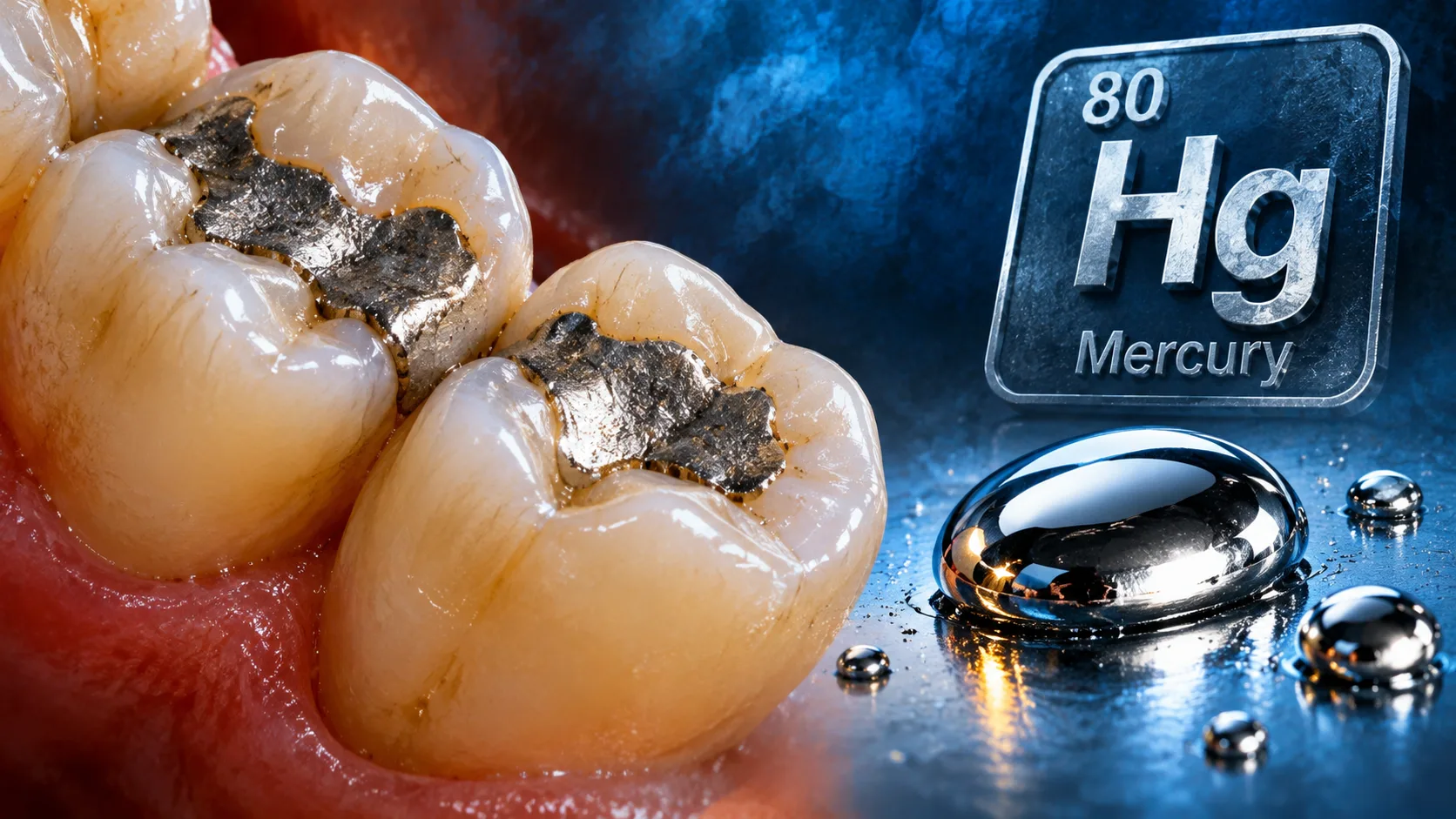
One of the things I discovered during my research was that dental amalgam contains approximately 50 percent mercury by weight.
Half the material.
That certainly got my attention.
I grew up thinking those fillings were simply silver fillings. Nobody explained their composition to me, and I never thought to ask.
Dental amalgam can release small amounts of mercury vapour, and drilling or removing amalgam can temporarily increase exposure.
The U.S. Food and Drug Administration acknowledges this and advises certain higher-risk groups to avoid new amalgam fillings when suitable alternatives are available.
The FDA also states that available evidence has not established harmful health effects from amalgam in the general population.
That’s an important distinction.
The fact that mercury vapour can be released doesn’t automatically establish that a person’s symptoms were caused by dental fillings.
And it doesn’t mean everybody with amalgam fillings is being poisoned.
But I do believe people deserve to understand what materials are being placed in their bodies and what questions they should ask before dental procedures.
You can read the FDA’s information directly:
I wish I’d understood more about those fillings when I was young.
I certainly would have asked a few more questions.
Why Mercury Can Be Difficult to Recognize
One reason mercury interested me so much during my research was the variety of symptoms associated with excessive exposure.
Depending on the form of mercury, the level of exposure, and the circumstances, mercury toxicity can affect the nervous system, kidneys, and other parts of the body.
Neurological symptoms can include tremors, changes in sensation, problems with memory or concentration, and disturbances in mood.
Some of those problems overlap with symptoms caused by many other conditions.
And that’s where things get complicated.
If you’re tired all the time, struggling to think clearly, or experiencing unusual sensations in your feet and hands, there can be numerous possible explanations.
Mercury is only one possibility among many.
But if you’re trying to understand persistent symptoms, I think it’s reasonable to examine your history of potential exposures alongside other possible causes.
That doesn’t mean diagnosing yourself from a symptom list.
It means asking better questions.
What substances have I been exposed to?
What kind of dental work have I had?
Have I worked around chemicals or other environmental hazards?
Could something in my history be relevant to what I’m experiencing now?
And what sort of investigation would actually help establish whether an exposure has affected me?
Those are questions I wish I’d been better equipped to ask decades ago.
The Internet Helped Me Ask Questions I Might Never Have Asked
Looking back, one of the most valuable things the internet gave me was access to other people’s experiences.
Before that, I might never have encountered the stories of Hyman, Pompa, or Mercola.
I might never have learned about their experiences with dental amalgam or the symptoms they attributed to mercury.
And I might never have considered certain questions about my own dental history.
That doesn’t mean everything you read online is reliable.
Far from it.
There’s plenty of nonsense out there, and it’s easy to find people who will tell you exactly what you want to hear.
But there’s also a tremendous amount of useful information if you’re prepared to investigate it carefully.
I wasn’t looking for somebody to tell me I was right.
I was looking for an explanation that made sense of what I was experiencing.
The stories I discovered became pieces of a much larger investigation.
They didn’t answer every question.
But they gave me more questions worth asking.
And sometimes that’s where understanding begins.
What I Would Do Differently Today
If I could go back to the days when I first started receiving dental fillings, I’d certainly approach things differently.
I’d want to know what materials were being used.
I’d ask about the alternatives.
I’d want an explanation of the risks and benefits.
And before undergoing extensive dental work, I’d make sure I understood exactly what was going to happen.
I wouldn’t simply assume that because a procedure was routine, there was nothing worth questioning.
That doesn’t mean I would rush to have every existing filling removed.
In fact, removing intact amalgam fillings unnecessarily can temporarily increase mercury exposure, and the decision needs careful consideration.
But I would insist on understanding my options.
That’s one of the most important lessons I’ve taken from my experience.
Ask questions before something goes wrong, not just afterward.
Could Mercury Exposure Be Behind Your Unexplained Symptoms?
I can’t tell you whether mercury has anything to do with your health problems.
And I’m not going to pretend that the experiences of three practitioners, or my own experience, can answer that question for you.
But I do think these stories are worth reading.
I found them years ago while searching for answers to my own health problems.
They stayed with me because I recognized something familiar in what those men were describing.
And after all these years, I still think there’s value in sharing them.
Perhaps you’ve had a similar experience.
Perhaps you’ve been dealing with persistent symptoms that nobody has satisfactorily explained.
Or perhaps you’re simply interested in understanding more about the materials and substances you’ve encountered throughout your life.
Whatever brought you here, I encourage you to read these firsthand accounts and decide what you think.
Don’t simply take my word for it.
Read Hyman’s story.
Read Pompa’s story.
Read Mercola’s account.
Consider the similarities and the differences.
And remember that personal experiences, however compelling, are starting points for investigation rather than proof of a diagnosis.
I’ve spent years trying to understand what happened to my health.
I don’t have every answer.
But I know one thing.
If I hadn’t started asking questions for myself, I might never have discovered some of the things I know today.
And that, to me, is what taking responsibility for your health is all about.