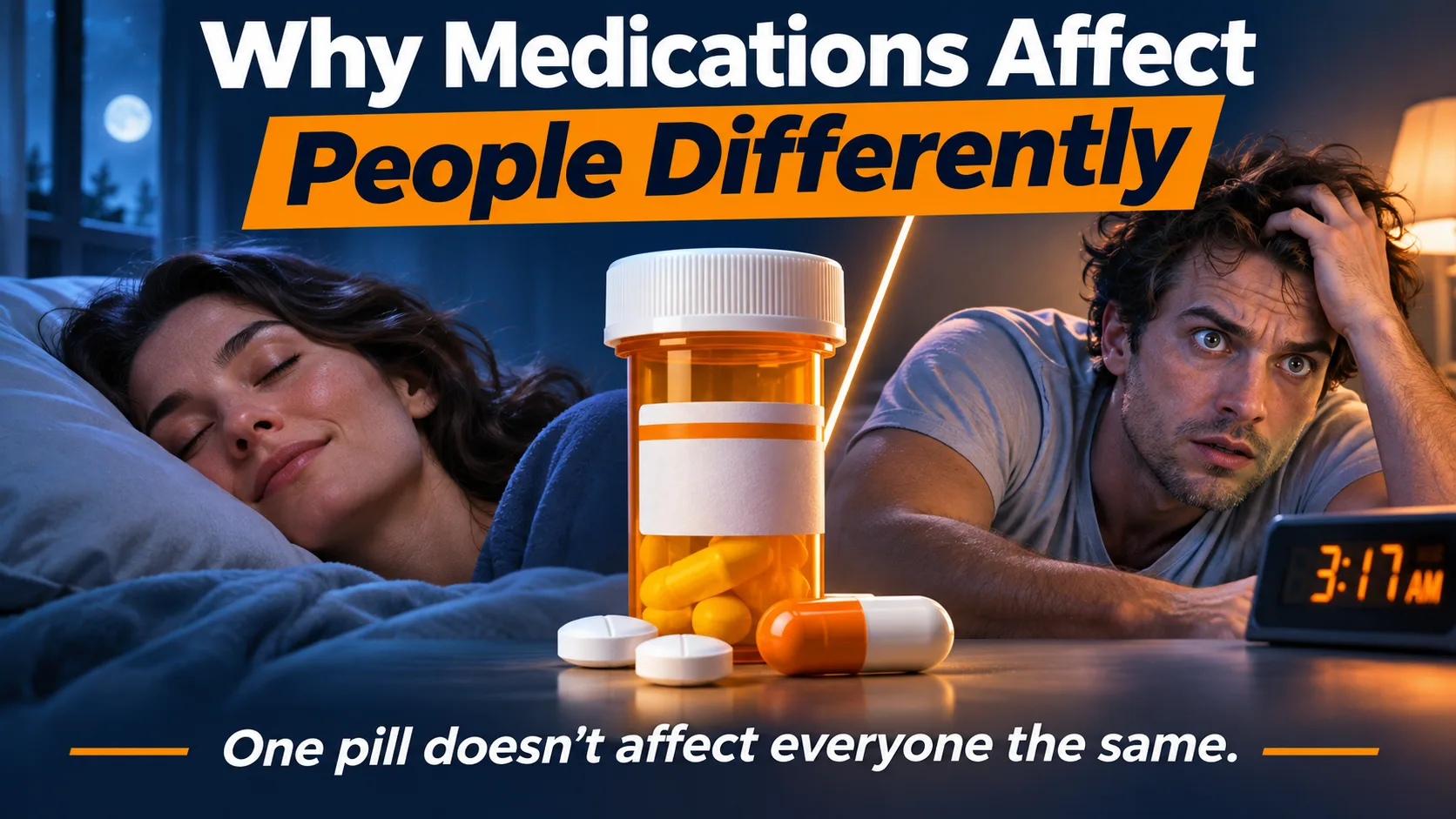
Years ago, when I was a lot younger, my friends and I occasionally took Valium to help us sleep after a night of partying.
Now, Valium is supposed to calm you down. It slows things down, relaxes you, and tends to make people sleepy. That was certainly our experience.
Except for one friend.
He took Valium and, instead of sleeping, told us it kept him awake for two and a half days.
Two and a half f’n days!
Think about that for a minute.
Here’s a medication that generally makes people drowsy, and this guy experienced what appeared to be the exact opposite reaction.
Same drug. Completely different experience.
I’ve never forgotten that story, and ever since, I’ve wondered why medications affect people differently.
Just because something works a certain way for you doesn’t mean it’s going to work that way for me.
And yet, for some reason, an enormous number of people seem incapable of understanding that simple concept.
Why Do Medications Affect People Differently?
I’ve encountered this thinking throughout my life, including within my own family.
Somebody takes a medication or supplement, has a particular experience, and immediately assumes everybody else should experience the same thing.
“Oh, you’ve got that problem? Take one of these. It worked for me.”
Really?
And what makes you think my body is going to respond exactly like yours?
I find that kind of thinking incredibly narrow-minded.
We’re all different people. Different genetics, different metabolisms, different histories, different lifestyles, different diets, and different things going on inside our bodies.
Some people can drink coffee at ten o’clock at night and go straight to sleep. Others have a cup in the afternoon and lie awake half the night.
Some people have a drink and become relaxed and sociable. Others become aggressive, depressed, or downright obnoxious.
We accept that people react differently to all sorts of things in everyday life.
So why the hell would medications be any different?
And why do so many people seem to assume that swallowing the same pill should produce the same result in everybody?
It doesn’t make sense to me.
Paradoxical Drug Reactions: When a Medication Does the Opposite
When I started looking more closely at the science, I discovered that what happened to my friend wasn’t simply some bizarre, unheard-of experience.
There’s a recognized phenomenon called a paradoxical drug reaction.
That’s when a medication produces an effect that runs contrary to what it’s generally expected to do.
And Valium is a particularly interesting example.
Valium, also known as diazepam, belongs to a class of medications called benzodiazepines. They’re commonly associated with calming effects, sedation, and muscle relaxation.
But here’s the interesting part.
The official prescribing information for Valium includes reports of stimulation, agitation, restlessness, hyperactivity, and insomnia.
Insomnia!
From a medication that commonly makes people sleepy.
Now, I can’t tell you exactly what happened inside my friend’s body that night. There were other circumstances involved, and nobody was conducting a scientific experiment.
But the reaction he described is remarkably similar to effects that have actually been documented.
So perhaps the real question isn’t whether different reactions happen.
It’s why we act so surprised when they do.
Your Genetics May Have Something to Say About It
Here’s where the subject gets even more interesting.
There’s an entire field of science devoted to understanding why medications affect people differently.
It’s called pharmacogenomics.
The basic idea is that differences in our genes can influence how our bodies process and respond to medications.
Some people break down certain drugs quickly. Others break them down more slowly.
For one person, a particular dose might produce the intended result.
For another, it might do very little.
For somebody else, that same dose could produce an unwanted or even dangerous reaction.
And this isn’t some fringe theory.
It’s an established area of medical research.
The National Human Genome Research Institute explains how genetic differences can influence medication effectiveness, drug metabolism, and the likelihood of certain adverse reactions.
Not every difference comes down to genetics, of course.
But the fact that an entire field of science exists to investigate these variations should tell us something.
Human beings are not interchangeable.
I’ve explored my own genetics, too. In my article about my experience with SelfDecode DNA testing, I explain why learning more about my individual biology became part of my long investigation into my health.
It’s Not Just Your DNA
Your genes are only part of the picture.
Consider everything else that can influence how your body responds to a medication.
Your age. Your weight. Your liver function. Your kidney function. Your nutritional status. Other medications you’re taking. Alcohol. Supplements. Your general state of health.
Even the same individual can respond differently to a medication at different stages of life.
What worked for somebody at 35 may not produce the same experience at 75.
Your body changes.
Your circumstances change.
Your physiology changes.
And yet we continue to talk about medications as though they’re going into identical machines.
They’re not.
They’re going into living, complicated human beings.
I’ve spent years trying to understand my own physiology, particularly after everything I went through with mercury exposure.
That experience taught me how little I understood about what was happening inside my own body.
And it also taught me something else.
Nobody else is living inside my body.
They can offer advice. They can share their experiences. They can tell me what’s worked for them.
But they can’t automatically assume their experience will be mine.
The Problem With One-Size-Fits-All Medicine
I understand why standardized medication doses exist.
Researchers study groups of people, evaluate benefits and risks, and develop recommendations based on the results.
That’s a reasonable starting point.
But a starting point isn’t a guarantee.
What works for the majority doesn’t necessarily work for every individual.
And that’s where I believe people need to start thinking differently.
When somebody tells you a medication worked wonderfully for them, that’s useful information.
It’s their experience.
But it’s not proof that the same medication will work wonderfully for you.
Likewise, if somebody has a terrible reaction, that doesn’t necessarily mean everybody else will.
We need to stop treating individual experiences as universal truths.
That includes my experiences, by the way.
I’ve tried countless supplements, diets, therapies, and approaches to improving my health over the years.
Some seemed to help. Some didn’t. And sometimes I was taking so many different things that it became nearly impossible to determine what was doing what.
That’s one reason I’ve become much more selective about what I take.
I’ve learned that throwing more things into the mix doesn’t necessarily produce better results.
And I’ve learned to pay much closer attention to how my own body responds.
I’ve written before about why I’ve given up on the modern medical system and chosen to focus on prevention. Part of that philosophy is refusing to surrender responsibility for understanding what happens inside my own body.
Your Body Is Giving You Information. Are You Paying Attention?
This is the part I really want people to understand.
If you take something and notice an unexpected change, don’t automatically dismiss your experience just because somebody tells you that the medication isn’t supposed to do that.
Maybe it isn’t supposed to.
But that doesn’t mean your experience is imaginary.
Pay attention to what changes, when it changes, and what else might be contributing.
Ask questions.
Look up the medication.
Read about its known effects and interactions.
If something isn’t working as expected, discuss that reaction with the person prescribing or dispensing it.
And don’t assume that taking more, taking less, or suddenly stopping a medication is the right answer. Those decisions can have consequences of their own.
The important thing is to recognize that your individual response matters.
We’re not all going to respond identically.
We never have.
I explored a related problem in What If You’re Smarter Than Your Doctor?. Sometimes you know something has changed inside your body, and you need someone willing to listen and investigate rather than simply dismiss what you’re experiencing.
Even Medical Research Recognizes Individual Differences
Here’s something else worth considering.
The MedlinePlus explanation of pharmacogenomics describes how the same medication may work well for one person, fail to help another, or cause adverse reactions in somebody else.
That is precisely the issue I’ve been talking about.
Science is already investigating why medications affect people differently.
The research is moving toward a more individualized understanding of drug treatment.
So why are so many people still thinking in terms of one pill, one result, everybody the same?
It seems to me that our everyday thinking needs to catch up with what researchers are already discovering.
Maybe It’s Time to Stop Thinking Like Everybody Has the Same Body
I keep coming back to my friend and that Valium.
Most of us expected to sleep.
He reported being awake for two and a half days.
And all these years later, that story still strikes me as a perfect illustration of just how differently human bodies can respond.
We don’t need to pretend that every medication affects every person in some wildly unpredictable way. Many drugs produce reasonably consistent results for large numbers of people.
But reasonably consistent isn’t the same as identical.
And it certainly isn’t a guarantee.
That’s the distinction I wish more people would understand.
I’ve spent a substantial part of my life questioning conventional assumptions about health, medicine, and the human body.
And the longer I do it, the more convinced I become that understanding your own physiology is one of the most important things you can do.
Listen to other people’s experiences.
Learn from them.
Research the science.
But don’t assume that what happened to somebody else is automatically going to happen to you.
One pill. Two people. Two completely different reactions.
How much clearer does it have to be?
One size does not fit all. And neither do we.