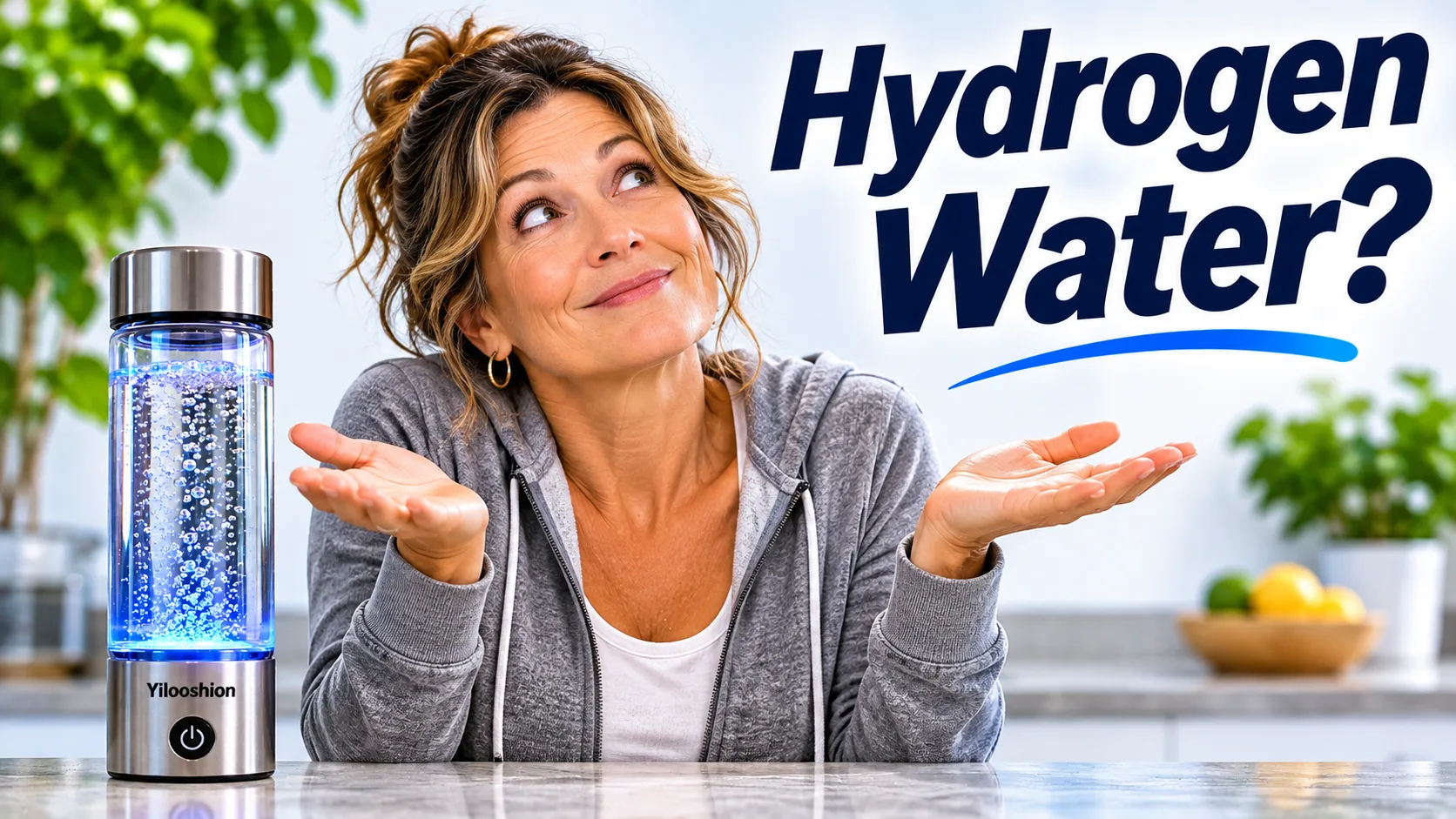
On May 30, 2025, I bought myself a hydrogen water bottle.
Why? Because I’d been hearing about hydrogen water and all the wonderful things it was supposedly doing for people’s health. Reducing inflammation, fighting oxidative stress, improving energy, slowing aging. You name it, somebody seemed to be claiming hydrogen water could help with it.
And I thought, what the hell? Maybe there’s something to this.
Nearly a year and a half later, I’m still using the damn thing every day.
But here’s the question I’ve been asking myself: Is this hydrogen water actually doing anything for me, or have I just developed another healthy-looking habit?
My Experience With Hydrogen Water
The bottle is a pretty clever little device. You fill it with water, press a button, and watch as thousands of tiny bubbles start appearing. The process is called electrolysis, and the idea is to dissolve molecular hydrogen gas into the water.
I’ve always used distilled water in mine. I figure that without all the minerals and other dissolved substances, there’s less opportunity for buildup inside the bottle.
I fill it almost to the top, run it through its cycle, and drink the water throughout the day. Usually, when I’m about two-thirds of the way through it, I fill it again and run another cycle.
I try to drink it fairly soon after making it because hydrogen is a gas, and some of it will escape over time. Keeping the lid tightly closed helps, but I know I’m probably losing some of it anyway.
The bottle also has a self-cleaning function, which I use regularly. After all this time, it’s still producing plenty of bubbles and seems to be working just fine.
So, have I noticed anything remarkable?
Not really.
I can’t honestly tell you that hydrogen water has given me more energy, made me younger, or cured anything. I haven’t experienced some dramatic transformation that I can point to and say, “There it is. That’s the hydrogen.”
But I haven’t stopped using it either. I like the idea that I might be giving my body something beneficial. And if there really is something to the science, maybe I’ve been doing myself some good.
Which brings me to what I find more interesting than the bottle itself.
Is There Any Real Science Behind Hydrogen Water?
As it turns out, there is.
And this isn’t something somebody dreamed up last year to sell water bottles on the internet.
Scientists have been investigating the possible biological effects of molecular hydrogen for decades. But a particularly interesting development came in 2007, when Japanese researchers published a study in the prestigious journal Nature Medicine.
Their research suggested that molecular hydrogen could help protect cells against certain forms of oxidative damage.
Now, this wasn’t a study showing that drinking hydrogen water makes people healthier. Much of the work involved laboratory experiments and animals, including rats exposed to hydrogen gas.
But it was enough to get scientists interested. And since then, researchers have been exploring hydrogen in drinking water, inhaled gas, and other forms.
You can read that original research here: Hydrogen Acts as a Therapeutic Antioxidant — Nature Medicine, 2007.
What Is Hydrogen Water Supposed to Do?
First, we’re not talking about the hydrogen that’s already part of ordinary water.
Regular water is H2O. Hydrogen water is simply regular water with additional molecular hydrogen gas, H2, dissolved in it.
Researchers are interested in whether this extra hydrogen can affect oxidative stress, inflammation, and the way our cells respond to damage.
Oxidative stress occurs when damaging chemical reactions overwhelm the body’s ability to manage them. It’s associated with aging and numerous health problems.
The theory is that molecular hydrogen might help regulate some of these processes.
I’ve always believed the body has a remarkable ability to look after itself when we give it the right conditions. I’ve written more about that in Your Body Was Built to Heal Itself. Are You Giving It the Chance? Whether hydrogen water contributes anything meaningful to that process is what I’m trying to find out.
Sounds pretty good, doesn’t it?
But a theory that makes sense in a laboratory is one thing. Showing that drinking hydrogen water actually improves human health is another.
What Have Human Studies Actually Found?
This is where I started paying attention.
There have been human clinical trials, and some of the results are encouraging. But the benefits appear to be considerably more modest than the advertising might lead you to believe.
Exercise and Fatigue
A 2023 review examined 19 studies involving 402 participants. The researchers found that molecular hydrogen supplementation produced small improvements in how hard people felt they were exercising and in certain measurements of blood lactate.
But here’s the other side of that finding: it didn’t significantly improve aerobic capacity or endurance performance.
Also, not every study involved drinking hydrogen water. Some used other ways of delivering hydrogen.
The research is worth reading: Effects of Molecular Hydrogen Supplementation on Fatigue and Aerobic Capacity, 2023.
Cholesterol and Metabolic Health
Another review, published in 2026, combined results from 13 randomized clinical trials involving 757 participants, mostly people who were overweight or had metabolic health problems.
The researchers found small reductions in total cholesterol and LDL cholesterol among people receiving hydrogen-rich water.
How small?
On average, total cholesterol fell by about 6.7 mg/dL compared with the control groups, while LDL cholesterol fell by about 3.2 mg/dL.
Those changes were measurable, but the researchers concluded they were too small to establish a meaningful reduction in cardiovascular risk.
That’s a useful finding, even if it isn’t exactly earth-shattering.
Here’s the study: Hydrogen-Rich Water and Blood Lipid Profiles — Systematic Review, 2026.
Inflammation, Aging, and Disease Prevention
This is where the claims become particularly interesting, and where I think we need to be careful about what the research actually shows.
Some studies have reported changes in markers associated with inflammation and oxidative stress. That’s certainly worth investigating.
But a change in a laboratory measurement doesn’t automatically mean someone is going to live longer, avoid disease, or feel noticeably better.
And despite all the talk about anti-aging benefits, there isn’t convincing human evidence that drinking hydrogen water extends lifespan.
I’d love to discover otherwise. At my age, I’m particularly interested in anything that might help me stay healthy for another couple of decades.
But wishing something worked isn’t the same as knowing it does.
Are Those Thousands of Bubbles Actually Hydrogen?
Every time I turn on my bottle, I watch thousands of little bubbles rising through the water.
It’s quite a show.
But seeing bubbles doesn’t tell me how much hydrogen is actually dissolving in the water, or how much of it I’m drinking.
The amount depends on the equipment, the concentration it can produce, and how much gas escapes before the water reaches my stomach.
That raises another interesting question: Are people using these bottles actually getting anything close to the hydrogen concentrations used in scientific studies?
Without testing the water, I really don’t know.
And running the bottle through extra cycles isn’t necessarily the answer. More bubbles don’t automatically mean more dissolved hydrogen, and I have no intention of experimenting with pressure inside a sealed container.
For now, I’m sticking with the normal operating cycle.
So Why Am I Still Drinking Hydrogen Water?
That’s a fair question.
I’ve been using this bottle for nearly 18 months, and I can’t point to one specific improvement in my health that I can confidently attribute to hydrogen water.
But I also haven’t found a compelling reason to stop.
I enjoy using it. It’s become part of my daily routine. I’m drinking water, which I need anyway, and perhaps getting a little something extra that may turn out to be beneficial.
I’ve always maintained that getting healthy is more about what we do consistently than chasing the latest health craze. That’s something I talked about in How to Get Healthy: Where Do You Start? And maybe hydrogen water is one more useful habit. Maybe it isn’t. That’s what I’d like to know.
The available research generally suggests hydrogen-rich water is well tolerated, although long-term human studies are still limited.
And frankly, I’m interested enough in the possibilities to keep watching the science.
I don’t need every healthy habit to produce some dramatic, immediately noticeable result. But I do want to know whether there’s a reasonable basis for doing it.
Hydrogen Water: My Verdict After Nearly 18 Months
So, is hydrogen water the latest miracle in a bottle?
I doubt it.
Is it complete bullshit?
I don’t think the research supports dismissing it that easily either.
There are legitimate scientific investigations, measurable biological effects, and some encouraging findings from human clinical trials.
What we don’t yet have is convincing evidence that drinking hydrogen water every day produces major, lasting improvements in health or longevity.
And that’s the part I’m most interested in.
I didn’t buy my hydrogen water bottle because I expected a miracle. I bought it because I was curious, because I’m always looking for ways to improve my health, and because I figured it might be worth trying.
Nearly a year and a half later, I’m still curious.
I’ll keep using my bottle for now. I’ll keep an eye on the research. And if somebody finally comes up with convincing evidence that this stuff really makes a difference, I’ll be delighted.
Until then, I’m drinking my hydrogen water, enjoying the bubbles, and keeping an open mind.