Strength training for seniors isn’t just about building muscle. It’s about preserving your independence, preventing physical decline, and being able to look after yourself as you get older.
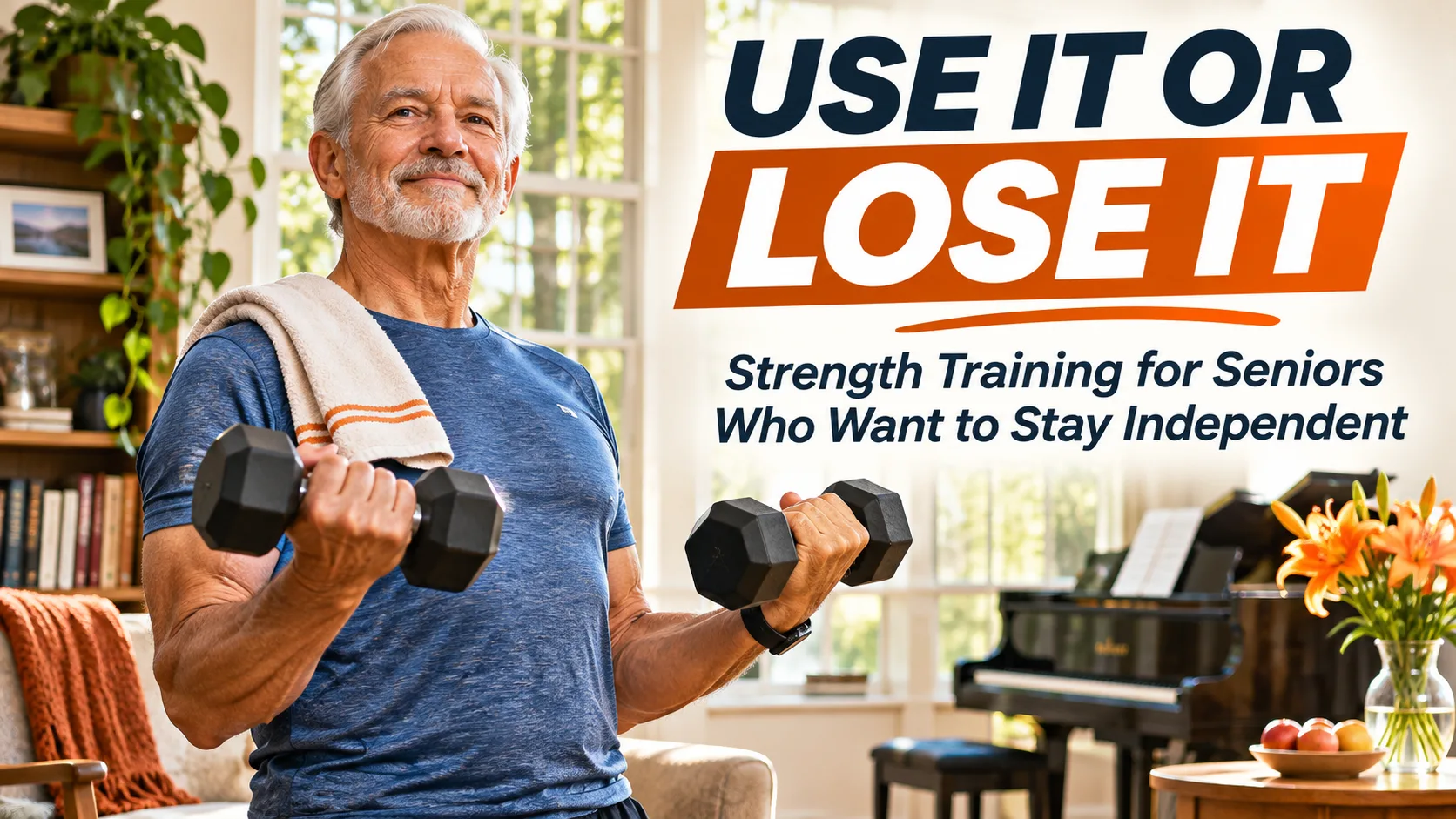
There’s an old expression we’ve all heard a thousand times: Use it or lose it.
Well, I’m 74 years old, and I’m here to tell you that when it comes to your muscles, your mobility, and your independence, there’s a hell of a lot of truth in those five little words.
Look around. How many people do you know who are finding it increasingly difficult to get out of a chair, climb a flight of stairs, carry their groceries, or simply get around?
I see it right here in the building where I live. People my age, and some considerably younger, are already relying on walkers and other mobility aids.
There are many reasons people lose mobility, of course. But one thing I wonder about is how much of that decline might have been delayed if they’d kept their bodies moving and their muscles working over the years.
Because here’s the question I think everybody should be asking:
How long do you want to remain capable of looking after yourself?
I don’t know about you, but I intend to remain independent for as long as I possibly can.
And I think we need to start taking that responsibility seriously long before something goes wrong.
Strength Training for Seniors Doesn’t Have to Mean Going to the Gym
I’ve got a couple of sets of dumbbells in my room. Ten-pounders and twenty-pounders.
They’re sitting right where I can see them.
And that’s important, because I don’t have some elaborate weight-training schedule. I don’t set aside an hour, change into workout clothes, drive to a gym, and follow a complicated program.
I just pick up the damn weights whenever I feel like it.
Sometimes I’m walking out of my room, I spot them, and I think, Have I done any lifting today?
So I stop, pick them up, and do 15 or 20 repetitions.
Then I put them down and go about whatever I was doing.
Sometimes I’ll come back and do something else later.
Bicep curls. Overhead exercises. Lateral raises. Squats with weights. Bent-over rows. Whatever I feel like working on.
I’ve used twenty-pound dumbbells for years, although I’ve noticed some exercises are becoming more challenging. That’s one reason I bought the ten-pounders.
I’m not trying to prove anything. I’m trying to keep using what I’ve got.
When I do a set of 15 repetitions, I generally start feeling the muscles working around repetition 12. The last few are challenging. That’s usually when I know I’ve done something worthwhile.
I’m not suggesting that my way is the perfect way to train.
I’m saying it’s a way that works for me because I actually do it.
And I suspect there are plenty of people who would benefit from taking a similar approach.
My Home Has Become My Exercise Space
There’s another reason I’ve adapted my exercise habits this way.
I help look after my 104-year-old mother, and that means I need to be home much of the time.
So I’ve incorporated exercise into my ordinary day.
We have a balcony with a railing. We have a grand piano. Both provide places where we can hold on for support while doing squats.
I can still do squats without holding on to anything. Mother needs support, and that’s fine. She works within her abilities.
In fact, she managed five squats yesterday.
At 104, I’ll give her credit for that!
I also stretch, move around, and dance to music several times throughout the day.
I’ve written before about free-form dancing to music, something I’ve enjoyed for most of my life.
It’s one of the easiest ways I know to get moving without feeling as though you’re following somebody else’s exercise instructions.
Put on some music you love and move.
Nobody’s judging your technique.
The point is to use your body.
And that’s really the philosophy behind everything I’m talking about here.
Find ways to move that fit your life instead of trying to rearrange your entire life around exercise.
Scientists Have a Name for This: Exercise Snacking
I recently discovered something interesting.
Researchers have been investigating a concept called exercise snacking.
Despite the rather strange name, the idea is simple: instead of doing all your exercise in one lengthy session, you perform short bouts of activity throughout the day.
Sound familiar?
A 2026 systematic review in the British Journal of Sports Medicine examined 11 randomized trials involving 414 participants.
The researchers found that brief exercise sessions improved muscular endurance in older adults, although the evidence was limited. They also reported adherence of approximately 83%.
You can read the exercise-snacking systematic review on PubMed.
Think about that.
People were actually sticking with the exercise.
That matters because even the most sophisticated workout program in the world won’t accomplish much if you don’t do it.
Another 2024 study examined a 12-week home-based program combining short strength exercises and Tai Chi movements in 90 older adults with impaired strength and balance.
The researchers reported improvements in lower-body strength, balance, and mobility.
The 2024 study is available on PubMed.
These studies don’t establish that randomly picking up a pair of dumbbells is equivalent to a complete exercise program.
But they do suggest that short, manageable periods of exercise can be a useful alternative for people who find conventional workout schedules difficult to maintain.
And personally, I find that encouraging.
Use It or Lose It: The Research Behind the Warning
Here’s where things get particularly interesting.
In October 2025, researchers published a study in the European Review of Aging and Physical Activity with a title that couldn’t be more appropriate:
Use It or Lose It: A Four-Year Follow-Up Assessing Whether Physical Activity Near One’s Capacity Reduces the Risk of Functional Decline Among Older Adults.
The researchers followed 312 adults between the ages of 75 and 85 over four years.
They compared people’s physical capabilities with how physically active they actually were.
And they found that older adults who engaged in more physically demanding activities generally experienced slower declines in physical functioning.
In other words, simply being capable of doing something isn’t necessarily enough.
You have to keep doing things.
The researchers even described one group as people who can do, but don’t do.
That really caught my attention.
Because it raises an obvious question:
If you’re physically capable of doing something today, why wouldn’t you keep using that ability while you’ve still got it?
This study doesn’t prove that everybody can avoid physical decline through exercise. Nothing guarantees that.
But it reinforces something I’ve believed for years: maintaining your physical abilities requires actually using them.
You can read the full Use It or Lose It study on PubMed Central.
You’re Not Training to Become a Bodybuilder
Let’s talk about what we’re actually trying to accomplish.
At my age, I’m not particularly interested in building enormous muscles.
I want to be able to get out of a chair without struggling.
I want to climb stairs, carry groceries, bend over, lift things, and get around without having to ask somebody else for help.
And I want to continue enjoying myself.
This past summer, I got back out on a tennis court a couple of times. I also spent some time throwing a Frisbee around in the park with a friend.
I hadn’t been doing those activities regularly.
But I was able to get out there, enjoy myself, and come home without suffering through a bunch of aches and pains afterward.
I can’t prove that my daily exercise habits were entirely responsible.
But I certainly believe they’ve helped me maintain the physical ability to do those things.
And isn’t that what all this is really about?
You maintain your strength so you can continue living your life.
Why Wait Until You Fall?
This brings me back to something I’ve been talking about on this website from the beginning.
Prevention.
Why do we so often wait until something goes wrong before we start paying attention?
We ignore our muscles until they become weak.
We ignore our balance until we fall.
We ignore our mobility until getting out of a chair becomes a struggle.
Then suddenly we’re interested in doing something about it.
Wouldn’t it make more sense to work on maintaining those abilities while we still have them?
Strength training is particularly important as we age because we naturally tend to lose muscle mass and strength over time.
That process, commonly called sarcopenia, can contribute to difficulties with everyday activities.
But age-related muscle loss isn’t something we have to accept without putting up a fight.
Resistance training can help maintain and improve muscle strength, and appropriately designed strength and balance exercises can reduce the risk of falls.
And you don’t necessarily have to begin with heavy weights.
You can start with what you’re capable of doing today.
A few supported squats. Some light dumbbells. Standing up from a chair. Walking. Stretching. Balance exercises.
The important thing is to begin—and keep going.
I wrote about this broader philosophy in Prevention: The Best Health Insurance There Is!
The choices you make today can influence how well you’re able to function tomorrow.
You Don’t Have to Do Everything. Just Do Something.
I don’t believe everybody needs the same exercise routine.
Your age, physical condition, available time, and personal interests all matter.
Some people love walking.
Others enjoy gardening, swimming, cycling, dancing, or lifting weights.
Some people need to begin with seated exercises or movements using sturdy support.
That’s fine.
I think the secret is finding activities you can realistically incorporate into your everyday life.
And remember, your muscles aren’t the only things that matter. Balance, flexibility, endurance, and coordination all contribute to maintaining your independence.
Personally, I like having several options available.
I can lift my dumbbells for a few minutes, do some squats, stretch, or turn on some music and dance.
Whatever floats your boat.
The important thing is to avoid spending your entire day sitting around doing nothing.
And as you become stronger, you can gradually make your exercises more challenging.
Because maintaining strength means giving your muscles a reason to stay strong.
Independence Is Worth Fighting For
Here’s what I really want you to think about.
Getting older is inevitable.
Becoming unnecessarily weak and dependent doesn’t have to be.
There are no guarantees. People develop illnesses, suffer injuries, and experience physical limitations for reasons beyond their control.
And there’s nothing shameful about needing help or using a mobility aid.
But that doesn’t mean we should surrender the physical abilities we still have.
I want to remain independent.
I want to look after myself.
I want to keep moving, enjoying life, and doing the things that make me happy.
And frankly, I don’t particularly look forward to the day when somebody else might have to wipe my ass.
There’s a little motivation for you.
So here’s my suggestion.
Don’t wait for some grand moment of inspiration.
Don’t wait until January 1.
Don’t wait until somebody tells you that you’re losing muscle or your balance isn’t what it used to be.
Start using what you’ve got today.
Put a pair of dumbbells somewhere you’ll see them. Find a safe place to do a few squats. Turn on some music. Get out for a walk.
Make movement part of your day.
Keep challenging yourself. Give your body time to recover. And keep doing what you’re capable of doing.
Because at the end of the day, this isn’t really about exercise.
It’s about freedom.
The freedom to look after yourself. The freedom to get around. The freedom to do the things you enjoy without becoming unnecessarily dependent on somebody else.
And if you want to keep that freedom for as long as possible, you have to do something to protect it.
Use it or lose it.
Insure Your Health Yourself.