I have had more than my share of problems with my teeth.
By the time I was 20, I had 16 mercury amalgam fillings in my mouth. Many of those fillings were later drilled out and replaced with more amalgam before I eventually had all of the mercury fillings removed.
So when it comes to my teeth, I don’t take anything for granted.
At 74, I pay more attention to my mouth than I ever have before. And during the last six to eight months especially, I have become much more disciplined about the way I care for it.
A big part of that change came from following dentist Dr. Ellie Phillips and learning more about her approach to xylitol and complete mouth care.
The result has been encouraging.
At my most recent dental appointment, my dentist first told me that everything looked good.
Then he stopped and corrected himself.
“Better than good.”
For somebody with my dental history, those were pretty satisfying words to hear.
I Don’t Think of It as Brushing My Teeth
I don’t really think of what I do anymore as simply brushing my teeth.
I think of it as treating my mouth.
There is a difference.
Brushing your teeth can become something you rush through because you are supposed to do it. What I do now is deliberate. It takes me about five or six minutes, and I actually watch the clock.
I generally do the complete routine twice a day—once after midday and again before bed.
I start by water-picking carefully around and between all of my teeth.
Then I rinse with CloSYS.
After that I brush for one minute with my left hand and one minute with my right hand. I concentrate heavily on the gums, both inside and outside, rather than just scrubbing away at the surfaces of my teeth.
Then I rinse with Cool Mint Listerine, followed by ACT mouthwash.
It is not complicated, but I don’t rush it.
For the first time in a long time, I feel as though I am actively looking after the entire environment in my mouth rather than simply brushing twice a day and hoping for the best.
Xylitol Benefits for Teeth
Xylitol has become another important part of that routine.
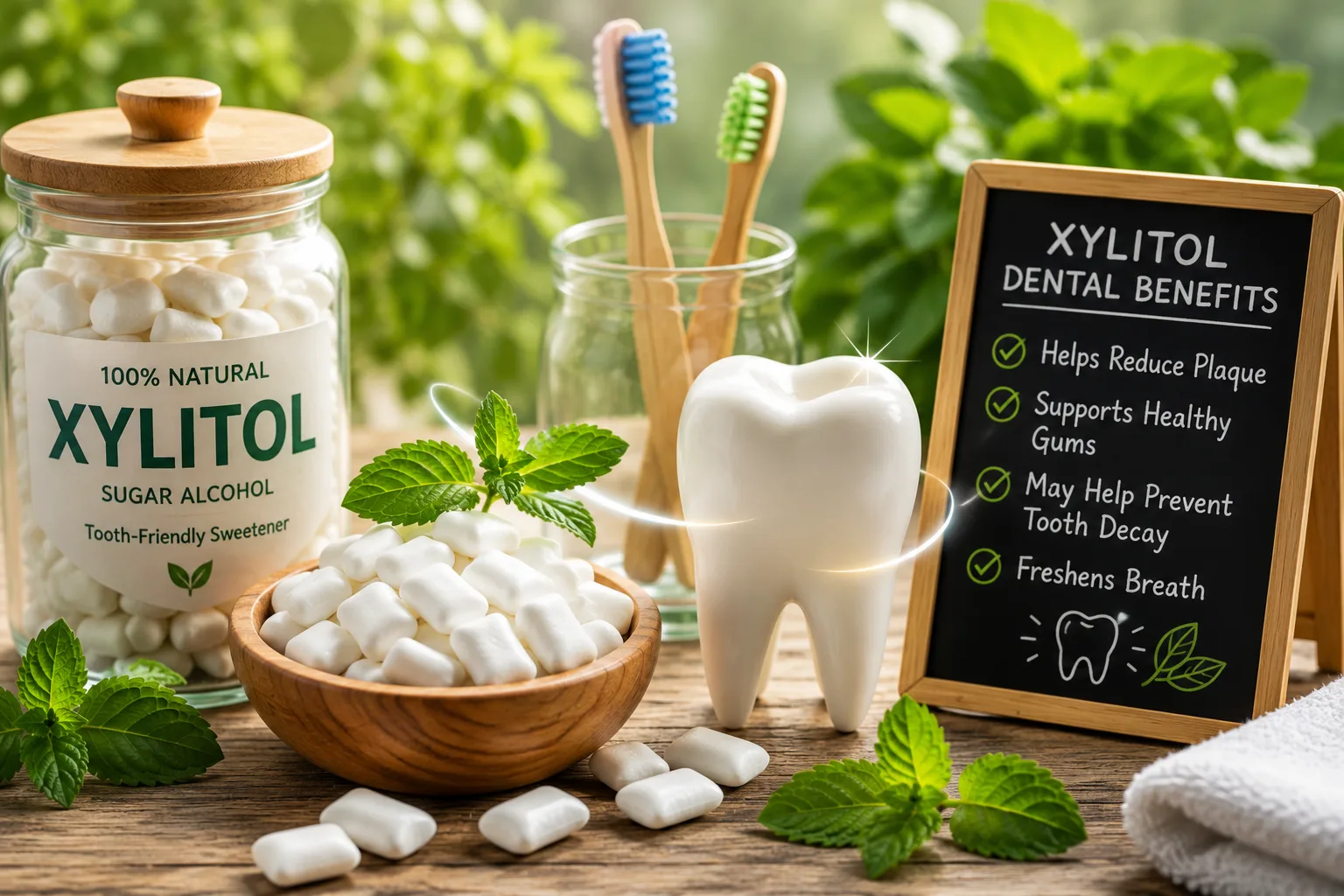
Xylitol is a sweetener found naturally in small amounts in fruits and vegetables. It tastes sweet, but the cavity-associated bacteria in the mouth do not use it in the same way they use ordinary sugar.
That is what originally interested me.
Dr. Ellie recommends using small amounts of xylitol several times throughout the day rather than taking a large amount all at once. Her general recommendation is roughly 5 to 10 grams over the course of a day.
I usually end up somewhere around that amount myself.
I use both xylitol gum and mints. Depending on the product, the amount in each piece varies, so I look at the label rather than simply counting pieces.
I particularly like using the gum after food or drinks. It has become almost automatic for me: I eat something, have something to drink, and afterward I reach for xylitol gum.
I also use xylitol mints, particularly when my mouth feels dry. My mouth tends to dry out somewhat during the night, so I sometimes use a mint in the evening or when I wake up with a dry mouth.
That combination—consistent mouth care plus regular xylitol—seems to have made a noticeable difference in my mouth.
Why Xylitol Interests Me
One of the things I like about xylitol is that it is simple.
It isn’t some elaborate treatment. I don’t have to make an appointment to use it. I can chew a piece of gum or let a mint dissolve in my mouth and then get on with my day.
Sugar-free chewing gum also stimulates saliva, and saliva is one of the mouth’s natural defenses. It helps wash away food particles, neutralize acids and return minerals to the surface of the teeth.
The American Dental Association notes that sugar-free gum containing xylitol can promote salivary flow and that cavity-causing bacteria cannot metabolize xylitol the way they metabolize ordinary sugars.
The research on exactly how much xylitol prevents cavities is not completely settled, and I don’t need to pretend that it is. What matters to me is that there is legitimate science behind its use, it is easy to incorporate into my day and, most importantly, I like what I am seeing in my own mouth.
What Dr. Ellie Changed for Me
I have followed Dr. Ellie for a couple of years, but during the last six or eight months I have followed her approach much more seriously.
One thing I appreciate about her philosophy is that she doesn’t talk about mouth care as simply attacking bad teeth after something has gone wrong. The emphasis is on creating an environment in the mouth that supports healthier teeth and gums.
That idea makes sense to me because it is very similar to the way I think about the rest of the body.
I am much more interested in prevention than waiting for something to break and then trying to repair it.
Her Complete Mouth Care System uses a specific sequence of products along with regular xylitol throughout the day. I have adapted that approach into the routine that I now follow consistently.
And consistency may be the biggest lesson of all.
Doing something once in a while is very different from doing it every day.
“Better Than Good” Means Something to Me
I want to be careful about claiming that one particular product caused everything to improve.
I changed several things at the same time. I became much more disciplined about my mouth-care routine. I use the rinses consistently. I spend more time on my gums. I water-pick thoroughly. And I use xylitol gum and mints throughout the day.
So I cannot tell you that xylitol alone is responsible for what my dentist saw.
But I can tell you this: my mouth is getting more attention than it has ever received, xylitol is an important part of that routine, and my dentist just told me that things looked better than good.
I’m going to keep doing what I’m doing.
The Goal Is to Keep Your Teeth
One of the ideas I have heard repeatedly from Dr. Ellie is very simple: the goal is not to create some imaginary perfect mouth.
The goal is to keep your teeth.
That means something to me at 74.
I have already had fillings, drilling, replacement fillings and years of dental problems. I cannot go backward and change what happened when I was younger.
But I can decide what I do today.
I can spend five or six minutes treating my mouth properly. I can pay attention to my gums. I can use products that seem to be helping me. I can use xylitol consistently. And I can try to make the teeth I have now last for the rest of my life.
That is prevention in its most practical form.
A Few Things Worth Knowing About Xylitol
Xylitol is generally easy for most people to use, but larger amounts can cause digestive upset in some people. That is another reason I prefer small amounts spread through the day rather than consuming a large amount at once.
There is also one warning that everyone using xylitol should know:
Keep xylitol away from dogs.
Although xylitol is safe for human use, it can cause a dangerous drop in blood sugar and other serious problems in dogs. Gum, mints and bags of xylitol should always be kept where a dog cannot get at them.
My Bottom Line
I spent a lot of years thinking of dental care mainly as something that happened in a dentist’s chair.
I don’t think that way anymore.
Most of what determines the condition of my mouth happens during all the ordinary hours when there isn’t a dentist anywhere near me.
It happens when I decide what to eat and drink. It happens when I take the time to water-pick. It happens during those two carefully timed minutes of brushing. It happens when I follow the rinsing routine instead of rushing through it. And for me, it happens when I reach for xylitol after eating or drinking.
Maybe that is why I like thinking of it as treating my mouth instead of simply brushing my teeth.
I am taking responsibility for it.
And after everything these teeth have been through, hearing my dentist say they look “better than good” tells me I am moving in the right direction.
To your health—and Insure Your Health Yourself!