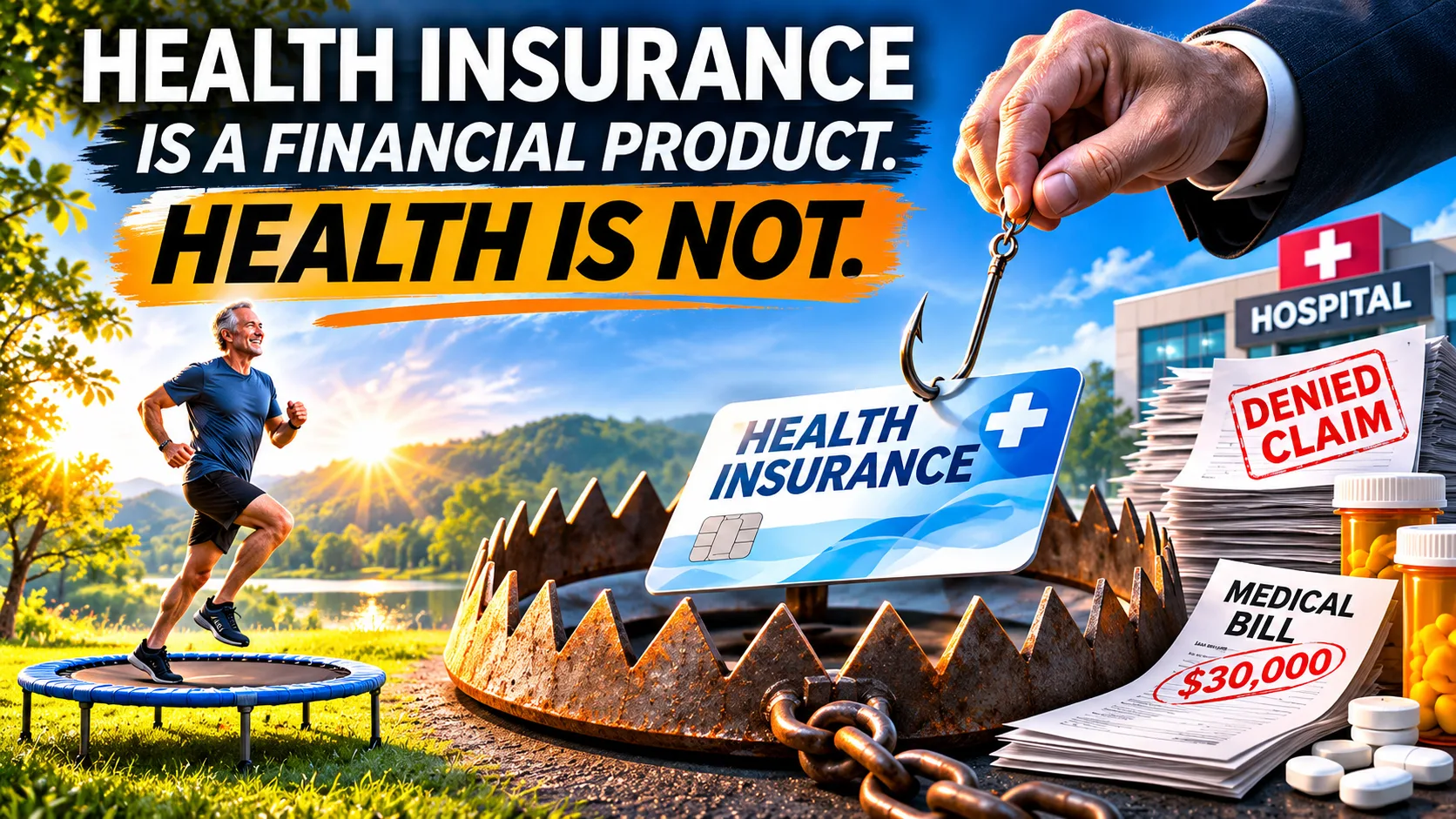
I was bouncing away on my trampoline this morning when it occurred to me that I hadn’t really written an article about the very thing that inspired the name of this website.
Health insurance.
Now there’s an interesting choice of words.
You give somebody a bunch of money every month, and somehow that transaction is supposed to have something to do with your health.
Does it?
Are you any healthier the day after you purchase a health insurance policy than you were the day before?
Of course not.
What you’ve purchased is an agreement with a company that may pay some of your expenses if something goes wrong with your health, provided those expenses are covered under the terms of your policy.
That’s a financial arrangement.
And I think we need to start making a very clear distinction between the two.
What the Hell Are We Insuring?
When you buy insurance for your car, you don’t suddenly stop changing the oil, checking the tires or maintaining the damn thing.
You understand perfectly well that having insurance doesn’t mean your car will continue to run properly.
So why don’t we apply that same common sense to our own bodies?
We’ve got people spending enormous amounts of money insuring themselves against the financial consequences of becoming sick. But how much time, money and effort are they putting into reducing the chances of becoming sick in the first place?
That’s the part of this whole business that drives me crazy.
I’m not questioning whether a medical bill can ruin somebody financially. Of course it can. I’m questioning how the hell we arrived at a point where protecting ourselves against the cost of sickness has become such an enormous industry, while protecting our actual health seems to get considerably less attention.
Look at What Is Happening in America
I’m a Canadian, and when I look at the American healthcare system from this side of the border, I find myself shaking my head.
The amount of money involved is almost beyond comprehension.
According to the OECD’s 2025 report, Health at a Glance, here is what the United States spends on healthcare compared with the average among OECD countries.
Those figures are in U.S. dollars, adjusted for purchasing power.
America is spending roughly two and a half times the average.
So surely Americans must have the best healthcare system in the world, right?
Well, apparently not.
The Commonwealth Fund’s 2024 comparison of healthcare systems in ten developed countries ranked the United States dead last overall.
Dead last!
How can you spend that much money and end up with those results?
Where is all that money going? Who is making it? And how much of it is actually being spent helping people remain healthy?
There’s a Hell of a Lot of Money in Sickness
Turn on an American television station and see how long you can watch before somebody tries to sell you a pharmaceutical drug.
Apparently there’s a drug for just about everything these days.
You’ve got smiling people dancing around, enjoying their lives, while somebody in the background rattles off a list of possible side effects that sounds more frightening than the condition they’re advertising the drug for.
And somehow we’ve come to accept this as perfectly normal.
I don’t.
Where are the advertisements encouraging people to get off their asses and exercise? Where are the campaigns teaching people how to prepare nutritious meals, maintain their muscle strength and develop habits that might keep them out of the hospital?
There’s no shortage of money available to advertise pharmaceutical products. There’s apparently no shortage of money available to build hospitals, develop new treatments and create increasingly complicated insurance arrangements.
But where is the comparable enthusiasm for prevention?
That’s another figure from the OECD’s 2025 report. The average across OECD countries was only 3.4%, so this isn’t exclusively an American problem either.
I think we have our priorities completely screwed up.
And What Happens When Your Insurance Doesn’t Pay?
Imagine spending years paying premiums to an insurance company, believing that you’ve protected yourself financially should something go wrong.
Then something does go wrong.
And suddenly you find yourself arguing with the company you’ve been paying all those years about whether or not you’re entitled to the coverage you thought you’d purchased.
How is that for peace of mind?
A January 2026 KFF survey found that nearly half of insured American adults had experienced a delay or denial involving a healthcare service, treatment or medication during the preceding two years.
So now, on top of whatever health problem you’re dealing with, you may also have a financial problem and an administrative battle on your hands.
Is this really the best system we’ve been able to come up with?
Personally, I find the whole arrangement appalling.
Is This Where Canada Is Heading?
Here in Canada, we’ve traditionally had a different approach. Medically necessary hospital and physician services are generally covered through our publicly funded provincial health insurance systems.
We’ve also had private insurance for things such as dental care, prescription drugs and other expenses that aren’t necessarily covered by our public plans.
But I’m becoming increasingly concerned about the direction we’re heading.
In December 2025, Alberta passed legislation establishing a framework that allows physicians to work within both the public and private systems.
The Alberta government calls this dual practice and presents it as a way of improving access and reducing waiting times.
Maybe it will. But I think Canadians should be paying very close attention to what happens next.
Are we going to end up with a system where the people who can afford additional private insurance get access to services that everybody else has to wait for?
And if so, where does it stop?
We have an extremely expensive example of a heavily commercialized healthcare system sitting right next door. Why on earth would we want to move in that direction?
I’d rather see Canada learn from the shortcomings of the American system than find ways to reproduce them.
Six Million Canadians Without a Family Healthcare Provider
Just this morning I was hearing again about the number of Canadians who don’t have access to a regular healthcare provider.
According to a Canadian Institute for Health Information report released November 26, 2026, approximately six million Canadians don’t have a regular primary healthcare provider.
And everybody is talking about how we’re going to find more doctors.
Now, I’ve personally never been particularly interested in having regular visits with a family doctor. My experiences with modern medicine have left me far more interested in learning about my own body and what I can do to maintain my health.
But here’s another question I think our governments should be asking.
What can we do to reduce the number of people who become sick and require ongoing medical treatment?
Surely that deserves at least as much attention as figuring out how to accommodate an ever-increasing demand for healthcare services.
Why isn’t that a much bigger part of the conversation?
My Father Was Talking About This in 1967
Perhaps the most frustrating part of all this, for me personally, is that my father was addressing this very subject almost sixty years ago.
On February 14, 1967, he stood in the Ontario Legislature and argued that governments should be doing considerably more to encourage physical fitness and prevent future healthcare expenses.
He understood the connection between what people do with their bodies when they’re young and what those bodies might cost the healthcare system decades later.
He wasn’t talking about building more hospitals.
He was talking about creating opportunities for people to remain healthy enough to spend less time in them.
You can read my father’s message about health here.
Almost sixty years later, we’re still arguing about healthcare costs.
How much further ahead might we be if we’d taken some of those ideas seriously back then?
What About Giving People an Incentive to Stay Healthy?
I’d love to see governments get a hell of a lot more creative about this.
Why not make exercise facilities more accessible? Why not provide greater financial incentives for people to participate in fitness programmes? Why not teach children how to prepare real food and understand what they’re putting into their bodies?
Why not make maintaining strength, mobility and independence a much greater priority for our aging population?
And why not invest more money in making nutritious food affordable and accessible?
These are things that could potentially benefit people for decades.
Instead, so much of our political conversation revolves around who is going to pay for healthcare after somebody gets sick.
Should the government pay? Should employers pay? Should individuals pay? Should insurance companies pay?
Everybody is fighting over who gets stuck with the bill.
I’d like to see considerably more effort put into reducing the number of those bills in the first place.
My Health Insurance Policy
At 74 years of age, I was on my trampoline this morning.
Nobody prescribed it. Nobody sent me a reminder that I was due for my morning exercise. And nobody from an insurance company showed up to encourage me.
I did it because I understand that maintaining my health requires something from me.
It requires participation.
Every time I exercise, every time I make a sensible decision about what I’m going to eat, and every time I do something that helps me maintain my strength and mobility, I’m investing in something that means far more to me than any financial product.
My ability to enjoy my life.
My independence.
My future.
I can’t purchase a guarantee that I’ll never get sick. But I’ll be damned if I’m going to sit around waiting for something to go wrong without doing everything I reasonably can to improve my chances.
That’s my idea of insuring my health.
It’s Time to Wake Up
I want people to start questioning this whole mentality.
Stop confusing having healthcare coverage with being healthy.
Stop assuming that because you’ve paid for something, you’ve necessarily accomplished something for your body.
Take a look at what you’re doing every day. Take a look at the things you might be able to change. And start putting some of your time, energy and money into protecting the one thing you can’t replace.
Yourself.
For all the billions of dollars changing hands in the healthcare industry, nobody else can do my morning exercise for me.
Nobody else can make my everyday decisions for me.
And no insurance policy is going to give me back the years I’ve wasted if I neglect my health.
That is the original idea behind this website.
It is why I called it what I did.
Sources and Further Reading
OECD — Health at a Glance 2025: United States
Healthcare expenditure and preventive healthcare spending.
The Commonwealth Fund — Mirror, Mirror 2024
International comparison of healthcare system performance.
KFF — January 2026 Health Tracking Poll
Insurance coverage delays, denials and administrative difficulties.
Government of Alberta — Dual Practice
Alberta’s framework for public and private physician services.
Canadian Institute for Health Information — Primary Healthcare in Canada, 2026
Access to regular primary healthcare providers.
Ivan W. Thrasher — My Father’s Message About Health
Ontario Legislative Assembly, February 14, 1967.